Wednesday, April 30, 2008

Super bike


Super bikes are large displacement super sport bikes. They have characteristics similar to the smaller super sport bikes which are mainly focused on race track performance, but are powered by larger engines that are usually sized around 800 cc (48.8 cu in) to 1,200 cc (73.2 cu in). A typical super bike will carry a wet weight between 400 lb (181 kg) to 480 lb (218 kg) and can produce 170 hp (127 kW). Super bikes with a displacement very close to 1,000 cc (61.0 cu in) are sometimes referred to as liter bikes as the engine displaces approximately one liter. Motorcycles in this class are usually eligible to participate in Superbike racing.

Examples include the Ducati 1098, Honda CBR1000RR, and Yamaha YZF-R1.

Suzuki GSX1300R hyper sport bike

[edit] Hyper sport

Hyper sport bikes are very large displacement sport bikes with a strong emphasis on top speed and acceleration. They typically are powered by motors displacing 1,100 cc (67.1 cu in) to 1,400 cc (85.4 cu in). Hyper sport bikes are bigger and heavier than super bikes with wet weights generally being close to 500 lb (227 kg). The increased weight compromises race track capabilities in favor of stability at very high speeds that can exceed 180 mph (290 km/h). This compromise also allows manufacturers to design much more comfortable rider ergonomics.

Examples include the Honda CBR1100XX, Kawasaki Ninja ZX-14, BMW K1200S and Suzuki Hayabusa.

BMW K1200GT sport touring bike

[edit] Sport touring

Main article: Sport touring

Sport touring bikes are designed with a longer distance riding emphasis. They typically feature more creature comforts than that of the average sport bike. Sport touring bikes are typically heavier, less powerful, and less performance oriented than super sport bikes, but have the added capabilities of storage, more comfortable rider ergonomics, and better practicality. Depending on the amount of emphasis on these touring capabilities, sport touring bikes can range from super sport bikes with more comfortable rider ergonomics to full-featured touring motorcycles with sport bike-like capabilities and features.

Sunday, April 27, 2008

Suzuki GSX Series

Among the earliest GSX models were the two-cylinder GSX 250 and the GSX 400.

These Suzuki GSX models were the evolution of the GS series of 2-valve per cylinder air and oil cooled four stroke motorcycles. The first 4-valve engines were produced for the 1980 model year, but retained the "GS" designation for the US market until the release of the GSX-R models in 1986 (1985 outside the US). These GSX engines were based on Suzuki's "TSCC" (Twin-Swirl Combustion Chamber) engine design, and shared little with previous 2-valve models. The bike called Suzuki Katana in the US had this engine design, with designations of GSX-S, but has little in common with the more modern GSX-F Katanas, which are sport-touring bikes.

The early GSX four-cylinder engines are arguably among the most reliable motorcycle engines ever mass-produced, with the 1100cc and 1150cc engines still very commonly used for drag racing and hillclimbing competition in the US.

The TSCC engine was once again redesigned in 1983 with the introduction of a completely new GSX 750, Suzuki's first modern mono-shocked sportbike in both a naked (GSX 750E) and half-faired (GSX 750ES) version. Although this bike received solid reviews from testing magazines (and came to be the testers' preferred 750 sport machine for the year), its release was an ill-timed duel against Honda's all-new V4 engine in the form of the VF750 Interceptor.

The 1983 GSX 750ES was a ground-breaking model in its own right, with air-adjustable anti-dive forks, preload and compression-adjustable rear mono-shock ("Full-Floater"), disc brakes at both ends. Some of the futuristic features it pioneered, like a fuel gauge, have since become far more commonplace. Others, like the digital gear indicator, turned out to be redundant marketing ploys now considered retro and obsolete.

The bike disappeared from dealers in 1984, to be replaced with the GSX 700 - a bike with a de-stroked engine and minor cosmetic differences. Minor tweaks included taller pistons and slightly differing cam lift and timing. This plus a change in factory gear ratios enabled Suzuki to produce a motorcycle with near-identical performance specifications to the GSX 750ES, even though engine displacement was 15 per cent smaller to satisfy the revised US import guidelines. These included increased tariffs imposed by the US government on all imported motorcycles displacing more than 700cc (repealed in 1988). This 50 per cent tariff was the reason behind the glut of de-stroked 650cc and 700cc Japanese motorcycles sold in the US in the mid-1980s - unique to the rest of the world - and is also the reason the GSX-R debuted in the US a full year later than the rest of the world.

This work was mostly in vain for the US market, however, as the GSX 750S Katana was completely restyled in 1984, and the GSX-R 750 was released abroad, painting a certain demise for the comparably ho-hum ES. 1984 also saw an update in color schemes for the GSX 750ES in the rest of the world, with the naked "E" being dropped in favor of the half-faired "ES" and a new "EF" model with full upper and lower sport fairings (never available as a factory option in the US).

The GSX 750E lived on for a few more years abroad, but was eventually superseded by the GSX-F series Katanas. The GSX-S Katanas were also dropped from Suzuki's regular lineup, replaced by the GSX-R series. The GSX 1100 lived on with significant styling changes for the 1984 model year, including a full-faired 124bhp monster of a musclebike, the GSX 1100EFE (US: GS1150EF). The larger bikes, although still sought-after as classic superbikes, were also replaced by the GSX-R and GSX-F Katana lineups, with significant body styling changes, upgraded suspension and braking components, and revolutionary frame revisions.

The GSX 750ES lives on in the market of previously owned bikes as an affordable all-around motorcycle, although with limited aftermarket and manufacturer support for parts. The US-only GS 700 is still fairly common ther

Wednesday, April 23, 2008

Honda fireblade


Background

In 1984 Kawasaki introduced the GPZ900 which reached 250 km/h and at same time was controllable. A year later Suzuki introduced the 176 kg GSX-R750F. The origin of the GSX-R was a factory developed model for endurance races and it was true racer. In 1986 Suzuki offered an even bigger and more powerful bike, the 198 kg GSX-R1100. This was argued to be the basis of a new breed of modern sport bikes, with the 5 valve Yamaha FZR1000T following it in 1987. From then on the Japanese machines only got heavier, and by 1992 the GSXR1100N was 225 kg and the 750 version was over 200 kg.

[edit] Development

Tadao Baba began design of the Fireblade, originally intended to use a 750 cc engine, in 1989. This was later changed to an engine with an 893 cc capacity so that existing production engines could be used.

[edit] Name

In the bike's early development, the name FIREBLADE came along, through a mis-translation from French to English for the Japanese word for lightning. It became the adopted internal name for the project's development, but all Honda inline-engined sport motorcycles of the time were labelled CBR, followed by a number approximately equal to the engine's capacity in CC. However, Baba-san had said that as the project came to launch, the internal name was chosen as the bike's marketing name so as not to emphasise the first Fireblade's 893 cc engine displacement, because at that time potential customers not accustomed to the new concept of lighter and agile superbikes would not perceive a motorbike of less than 1000 cc as a top performer.

[edit] History

Launched in 1992, the CBR900RR's large displacement engine coupled with its relatively light weight and nimble frame was unheard of. Since then there have been numerous variations from the original 893 cc Blade to the current CBR1000RR.

[edit] 1992 CBR900RR

Main article: Honda CBR900RR

At 407 lb (185 kg) and putting out approximately 124 horsepower (92 kW) from its inline 4 cylinder engine, the original Fireblade defined a new genre - big displacement bikes that were as light as, if not lighter than, their 600 cc counterparts.

The first 893 cc Blade sold quickly, even with a relatively high UK list price of £7390. Demand soon out stripped supply, as riders could not believe just how fast, light weight, a class breaking 185 kg and easy to ride this new bike was, especially in the hands of rider's more used to the heavy weight bikes of the time, eg: Kawasaki ZX10, Suzuki GSX-R1100, and Honda's own CBR1000F.

It was widely regarded as one of the best-handling sport bikes ever although there were some calls for a steering damper initially due to the 16-inch (410 mm) front wheel making the front seem twitchy. It was soon proven to be the correct choice of wheel, as the reduced unsprung weight of a 16-inch (410 mm) wheel over a 17-inch (430 mm) improved turning ability. The steering geometry was also virtually identical to the Kawasaki KR1-s 250 cc two stroke which although a road going bike was widely used for racing and was known as a 'proddie bike for the road'. The Fireblade's statistics on paper raised a few eyebrows before launch because of this. The bike was tested with help by Phillip McCallen, a professional racer who also raced the Fireblade at the Isle of Man TT.

Purists and fans of the Fireblade believe the early models to be the best as later models became more 'refined' and easier to ride to cater for mass appeal as opposed to true sports bike riders.

The first colors were red/white/blue and the menacing black and silver version.

Over the next few years, the Fireblade saw some minor updates as the bike received some new clothes in the shape of a redesign to the bodywork, as the now familiar Foxeye/Urban Tiger came along in December 1993, and soon sold out, as it had the year before, even at the list price of £8195.

[edit] 1995 CBR918RR

November 1995 saw a big revamp, unusual for Honda, as the RRT model was released with an all new dedicated 918 cc engine, not the previous Japan-only bored-out 750 engine. A revised suspension package and other updates to the riding position gave the rider a little more civility. List price was an even more extortionate £9265.

In 1997 The RRV was released but although the power was increased by a few bhp little had changed from the 1996 bike, except a new set of colour schemes and a slight weight loss now 183 kg, due to a new aluminium silencer.

[edit] 1998 CBR900RR

Although radically changed the public didn't respond well, Honda couldn't keep up with the new Yamaha R1 or Kawasaki ZX-9R which at the time had performance way out of the ballpark.

[edit] 2000 CBR929RR

The millennium year Fireblade had an all new fuel injected 929 cc engine, inverted forks and a much awaited 17-inch (430 mm) front wheel. Honda had also given the bike a squarer look, with a dry weight of 170 kg, losing 9 kg in the process. But again the bike lost out to the Yamaha R1 in the sales charts. The 929 lasted for only two years, in the guises of model RR6 and RR1.

[edit] 2002 CBR954RR

A CBR929RR with a bigger capacity engine created models RR2 and RR3. It had an altogether much leaner, sleeker, tougher look due to every body panel being altered from the previous year. The new 954 Fireblade made 149 bhp (111 kW) and 77 ft·lbf (104 N·m) of torque, due to a heavily improved EFI system with bigger injectors and more processing ability. It also handled better due to frame and headstock strengthening, and a more rigid swingarm. Weighing in at a class leading 168 kg, it also weighed less than Honda's own CBR600RR.

[edit] 2004 CBR1000RR

Main article: Honda CBR1000RR

The CBR1000RR finally enabled the venerable Fireblade to arrive at a true litre of displacement to more easily compete with litre bikes from Yamaha, Suzuki and Kawasaki. Developed by the same team that was behind the Honda RC211V race bike for the MotoGP series.[1] Many of the new technologies introduced in the Honda CBR600RR, a direct descendent of the RC211V, were used in the new CBR1000RR such as a lengthy swingarm, Unit Pro-Link rear suspension, and Dual Stage Fuel Injection System (DSFI).

Almost no parts of the CBR954RR were carried over to the CBR1000RR Development The compact 998 cc in-line four was a completely fresh design, with unique bore and stroke dimensions, race-inspired cassette-type six-speed gearbox, all-new ECU-controlled ram-air system, dual-stage fuel injection, and center-up exhaust featuring a new computer-controlled butterfly valve. The chassis was likewise all new, including an organic-style aluminum frame composed of Gravity Die-Cast main sections and Fine Die-Cast steering head structure, inverted fork, Unit Pro-Link rear suspension, radial-mounted front brakes, and a centrally-located fuel tank hidden under a faux cover.

A longer swingarm acted as a longer lever arm in the rear suspension for superior traction under acceleration and more progressive suspension action. Substantially longer than the corresponding unit on the CBR954RR (585 mm compared to 551 mm) the CBR1000RR's 34 mm-longer swingarm made up 41.6% of its total wheelbase. The CBR1000RR's wheelbase also increased, taping out at 1405 mm (55.3 inches), a 5 mm increase over the 954.

Providing room for a longer swingarm required massive changes to the engine architecture, another reason the CBR1000RR power plant shares nothing with the 954. Shortening the engine compared to the 954 meant rejecting the conventional in-line layout. Instead, engineers positioned the CBR1000RR's crankshaft, main shaft and countershaft in a triangulated configuration - like the Yamaha R1.

Sunday, April 20, 2008

300 CC

During a conversion about new bikes in India, my friend was talking about Bajaj, India’s largest and world fourth largest two wheeler manufacturer revolutionary in India. Frankly speaking I am no fan of Bajaj Products I always believe in companies like TVS, Yamaha and Honda when it comes to biking.

Talking about my friend who alerted me about Bajaj’s upcoming release of a new powerful biking which is probably the BAJAJ PULSAR 300CC. At first it was 100CC then 120,150,180,200 and now its 220cc.

So now a 300 cc bike for Indian roads? Are we power drivers? Already Price of fuel is sky rocketing while traffic in parallel increases. Soon I went through a research over internet about Bajaj launching the new 300cc bike to confirm the news.

At last I concluded it is PURELY HOAX. Bajaj has officially not announced any plans to launch 300cc right now in India. So if you come across any news about it then it’s completely one of false gossips.

pulsar300cc1.jpg

Above is the picture of Virtual stimulated photography of Pulsar claiming to be 300cc bike from Bajaj.

Lastly guys please don’t offend me I don’t like Bajaj products due to their constant discontinuation of vehicle models. Some of examples are they discontinued Sunny, Chetak, Cub, Super, Wave, Legend, Bravo, Eliminator, Wind 125, Kawasaki 4s Champion, Kawasaki KB 100 RTZ, Boxer and Caliber. No news at all about Blade and Sonic.

Do anyone ever thinked about the customers using the above model vehicles? Are they assured with any availability of Spare parts? So I usually depend on TVS and other companies! Although many companies constantly discontinue vehicles when they are out of fashion but Bajaj has a biggest list.

*This is my personal opinion and it has nothing to do with real criticism if so it is purely due to the coincidence.

Anyways do you have plans to buy a new bike? What’s your choice ?

ShareThis

Tuesday, April 15, 2008

Cyclo-cross bicycle

Frame design

Frame materials are selected with an aim to produce a lightweight, stiff frame. Lightness is prized for ease of carrying while running. A cyclo-cross racer may have lifted or carried his bike as many as 30 times in one 60 minute race, increasing the need for a lightweight bicycle. Aluminum frames were popular long before they became commonplace on the road. Today the most popular material is aluminum with carbon fibre being popular at a professional level and steel and titanium being favorites amongst those searching for a smoother ride and a longer lasting frame.

Cyclo-cross frames require clearance for slightly fatter (generally 30-34 mm) tires and the debris and mud that is picked up by them. They are typically very simple, often eschewing bridges between the rear stays. Other features that combat build-up of mud are top tube (rather than bottom bracket) routed derailleur cables. Some specialist cyclo-cross bikes also have a higher bottom bracket to aid clearance over rough ground; extra clearance could prevent toe clips from dragging while re-mounting after an obstacle. This is less and less common as clipless pedals have become the norm for cyclo-cross.

[edit] Components

Surly Crosscheck cyclo-cross bicycle with Campagnolo groupset and a single chainring

Cantilever brake bosses are mounted with the traditional design of brake preferred to V-brakes, again to prevent clogging with mud. Wheels are of the normal road racing type fitted with knobbie tires (a variety of tread designs in both tubular and clincher types are available), and gearing is a little lower. There are also slight geometry differences between the two; cyclo-cross bikes tend to have slightly higher handlebars for a more upright position as aerodynamics have little importance in a cross race. A second set of brake levers on the tops, called top mount brake levers, are favored by some competitors. In general, with a change of tires and gearing a cyclo-cross bike can double as a perfectly adequate road racing machine. However, most cyclo-cross racers prefer clipless mountain bike pedals for their easy dual-sided entry and mud-shedding abilities. Also, the mountain bike shoes used with them provide better traction whilst running than a typical road style shoe thanks to grip and flexibility in the sole. Gearing is typically lower, with most common setups using a 46-38 chainring combination with a 12-27 cassette cluster.

Choices of equipment tend more towards the idiosyncratic than in road racing; for example single-speed bicycles also have some popularity due to the advantage of mechanical simplicity in the often very muddy conditions and the fringe nature of the sport. Some riders opt to use a single chainring in the front (typically a 40-42 tooth chainring) while retaining gears in the rear cassette. This has some of the advantages of the single-speed: the weight of the front derailleur and the front shift lever are lost, fewer mechanical problems arise (there is less danger of the chain falling off), and racing is psychologically simpler.

Friday, April 11, 2008

dirt bikes

This article uses British English. See talk page for more information.

A motorcycle or motorbike is a single-track, two-wheeled motor vehicle powered by an engine. Styles of motorcycles vary depending on the task for which they are designed, such as long distance travel, navigating congested urban traffic, cruising, sport and racing, or off-road conditions. In many parts of the world, motorcycles are among the least expensive and most widespread forms of motorised transport.

Contents

[hide]

[edit] History

Main article: Motorcycle history
Replica of the Daimler-Maybach Reitwagen
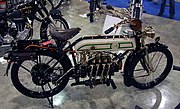
A 1913 Fabrique National in-line four with shaft drive from Belgium
A  pre-war Polish Sokół 1000
A pre-war Polish Sokół 1000

The inspiration for arguably the first motorcycle was designed and built by the German inventors Gottlieb Daimler and Wilhelm Maybach in Bad Cannstatt (since 1905 a city district of Stuttgart) in 1885.[1] The first petroleum-powered vehicle, it was essentially a motorised bicycle, although the inventors called their invention the Reitwagen ("riding car"). However, if one counts two wheels with steam propulsion as being a motorcycle, then the first one may have been American. One such machine was demonstrated at fairs and circuses in the eastern U.S. in 1867, built by Sylvester Howard Roper of Roxbury, Massachusetts.[1]

In 1894, Hildebrand & Wolfmüller became the first motorcycle available for purchase.[2] In the early period of motorcycle history, many producers of bicycles adapted their designs to accommodate the new internal combustion engine. As the engines became more powerful, and designs outgrew the bicycle origins, the number of motorcycle producers increased.

An historic 1941 Crocker

Until the First World War, the largest motorcycle manufacturer in the world was Indian, producing over 20,000 bikes per year. By 1920, this honour went to Harley-Davidson, with their motorcycles being sold by dealers in 67 countries, until 1928 when DKW took over as the largest manufacturer.

After the Second World War, the BSA Group became the largest producer of motorcycles in the world, producing up to 75,000 bikes a year in the 1950s. The German company NSU Motorenwerke AG held the position of largest manufacturer from 1955 until the 1970s.

NSU Sportmax streamlined motorcycle, 250 cc class winner of the 1955 Grand Prix season

In the 1950s, streamlining began to play an increasing part in the development of racing motorcycles and held out the possibility of radical changes to motorcycle design. NSU and Moto-Guzzi were in the vanguard of this development both producing very radical designs well ahead of their time.[3] NSU produced the most advanced design, but due to the deaths of four NSU riders in the 1954–1956 seasons, they abandoned further development and quit Grand Prix racing.[4] Moto-Guzzi produced competitive race machines, and by 1957 nearly all the GP races were being won by streamlined machines.[citation needed]

From the 1960s through the 1990s, small two-stroke motorcycles were popular worldwide, partly as a result of East German Walter Kaaden's engine work in the 1950s.[5]

Today, the Japanese manufacturers, Honda, Kawasaki, Suzuki, and Yamaha dominate the motorcycle industry, although Harley-Davidson still maintains a high degree of popularity in the United States. Recent years have also seen a resurgence in the popularity of several other brands sold in the U.S. market, including BMW, KTM, Triumph, Aprilia, Moto Guzzi and Ducati.

Outside of the USA, these brands have enjoyed continued and sustained success, although Triumph, for example, has been re-incarnated from its former self into a modern world-class manufacturer. In overall numbers, however, the Chinese currently manufacture and sell more motorcycles than any other country and exports are rising. The quality of these machines is asserted to be somewhat lower than their Japanese, European and American counterparts[citation needed].

Additionally, the small-capacity scooter is very popular through most of the world. The Piaggio group of Italy, for example, is one of the world's largest producers of two-wheeled vehicles. The scooter culture has, as yet, not been adopted widely in North America.[citation needed]

[edit] Technical aspects

[edit] Construction

Motorcycle construction is the engineering, manufacturing, and assembly of components and systems for a motorcycle which results in performance, cost and aesthetics desired by the designer. With some exceptions, construction of modern mass-produced motorcycles has standardised on a steel or aluminium frame, telescopic forks holding the front wheel, and disc brakes. A one- to eight-cylinder gasoline powered engine coupled to a manual, five- or six-speed sequential transmission drives the swingarm-mounted rear wheel by a chain, driveshaft or belt.

[edit] Fuel economy

Motorcycle fuel economy benefits from the relatively small mass of the vehicle, compared to its passengers and to other motor vehicles, and subsequent small engine displacement. However, poor aerodynamics of exposed passengers and engines designed for goals other than fuel economy can work to reduce these benefits. Riding style has a large effect on fuel economy: some riders report being able to double fuel economy by using low accelerations and lower speeds than usual, although this is the extreme case.

Fuel economy varies greatly with engine displacement and riding style ranging from a low of 29 mpg (US) (12 km/l/35 mpg imp) reported by a Honda VTR1000F rider,[6] to 107 mpg (US) (45 km/l/129 mpg imp) reported for the Verucci Nitro 50 cc Scooter.[7] A specially designed Matzu Matsuzawa Honda XL125 achieved 470 mpg (US) (200 km/l/560 mpg imp) "on real highways - in real conditions."[8]

[edit] Dynamics

Racing motorcycles leaning in a turn.

Motorcycles must be leaned in order to turn. This lean can be induced by a method known as countersteering, in which the rider turns the handlebars in the direction opposite of the desired direction of turn. In other words, press forward on the handgrip in the desired direction—press right to go right, press left to go left. This concept is counter-intuitive and often very confusing to novices—and even to many experienced motorcyclists.[9]

Short wheelbase motorcycles, such as sport bikes, can generate enough torque at the rear wheel and enough stopping force at the front wheel to lift the other wheel off the pavement. These actions, if performed on purpose, are known as wheelies and stoppies respectively. If carried past the point of recovery the resulting upset is known as "looping" the vehicle.

[edit] Additions

Various additions may be attached to a motorcycle or come as an integral part of a motorcycle from the factory.

Fairing on a Honda Gold Wing
Fairing / screen

A plastic or fibreglass shell, known as a "fairing", is placed over the frame on some models to shield the rider from the wind, aid in aerodynamics and protect engine components in an accident. Drag is the major factor that limits motorcycle speed, as it increases at the square of the velocity, with the resultant required power increasing with the cube of velocity. As evident in the streamlined appearance of new performance motorcycles, there is much aerodynamic technology included in the design. Since the 1958 FIM ban on motorcycle designs that cover the wheels or the rider, e.g., "dustbin" fairings, no major manufacturer has provided fairing to overcome the effect of the turbulence caused by the spinning front wheel, which prevents the motorcycle from cutting a clean path through the air. "Dustbin" fairing can improve aerodynamic performance without substantially compromising the rider's ability to control the machine, if the fairing is designed and tested for the effects of side winds.

Screens, also called windshields or windscreens, can be built into a fairing or be attached to an otherwise unfaired bike. They are usually made from transparent high-impact acrylic plastic. They may be shaped specifically to direct air flow over or around the head of the rider even if they are much shorter than the seated rider.
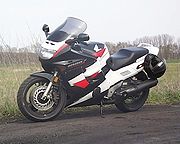
An example of a fairing on a Honda CBR1000F

In the absence of a fairing or screen, a phenomenon known as the windsock effect occurs at speeds above 100 km/h (62 mph), where the rider becomes a major source of drag and is pushed back from the handlebars, tiring the rider.[citation needed] However, these motorcycles still effectively push their way through the atmosphere with brute force. A cabin cycle, which has a hull that wraps around the basic cycle frame, solved the problem of aerodynamics by isolating driver from outside air.

Modern fairings on touring and sport-touring motorcycles dramatically improve a rider's comfort and attention on long rides by reducing the effect of the wind and rain on the body. They also help keep a rider warm in cold weather or high wind chill conditions, reducing hypothermia. Heated hand grips, and even heated seats, also improve rider comfort in cold weather. Motorcycles from a number of manufacturers now have electric screens, introduced on the 1986 BMW K100LT, which raise and lower the screen with the push of a button to the optimum height for conditions.

Craven's Golden Arrow panniers
Saddlebags or panniers

Saddlebags or panniers mount on either side of the rear wheel behind the saddle to carry parts, tools, and/or travel gear. They can be made of fiberglass, ABS, leather, Cordura, or other appropriate sturdy material. They are normally standard items on touring motorcycles, but are usually optional on other types of motorcycles. They can be model-specific and available from a motorcycle's manufacturer, or after-market and designed to fit on numerous models.

Heated handgrips on a BMW
Heated hand grips/seats

As motorcycles lack climate control or proper protection from the wind, some manufacturers offer heated seats or hand grips to relieve the discomfort of low temperatures experienced during night riding or the colder months. They can also be added on as after market accessories and are powered by the bike's electrical system.

Luggage rack

A common addition to many bikes is an attachment onto which bags or other luggage can be fastened. This removes the need for rider backpacks and is generally a more secure and safe way to add carrying capacity to a motorcycle.

Sidecar
Main article: Sidecar
IMZ-Ural motorcycle with sidecar

A sidecar is a one-wheeled device attached to the side of a motorcycle, producing a three-wheeled vehicle. Early sidecars were removable devices that could be detached from the motorcycle. Sidecars gradually superseded forecars and trailers. The forecar comprised a two-wheeled attachment at the front of the motorcycle. The trailer was just that, pulling the passenger along behind. In neither case could rider and passenger converse easily, and early sidecars were often called 'sociable' attachments.